


17/06/2026 02:57 PM
A wooden gate is more than just an entrance. It provides safety, security, and privacy, sets the tone for a property, and provides a reliable access point that should help, not hinder your lifestyle. Yet not all wooden gates are created equal. While many may look similar on day one, the real test comes over time, as weather, movement, and use all take their toll.
So what actually makes a good wooden gate? The answer lies in the construction details, the preparation of the timber, and the engineering behind it. If you are looking specifically at garden gates, you may want to read our blog: what makes our garden gates unique.
1. Proper Joinery: Morticed and Tenoned Structure
At the heart of any quality wooden gate is the frame or the skeleton structure including the rails and stiles; the strongest are morticed and tenoned. This traditional joinery method involves forming a tongue (the tenon) on one piece of timber that fits precisely into a slot (the mortice) in another. Once secured into place, the joint becomes exceptionally strong.
This matters because gates are under constant stress. They carry their own weight, they are opened and closed repeatedly, and they experience seasonal movement as timber responds to changes in moisture. Morticed and tenoned joints distribute these forces far better than basic screwed or nailed frames, helping the gate retain its shape and rigidity for years.
While cheaper gates may rely on surface fixings or mitre joints, these almost always loosen over time. Good joinery is not always visible at first glance, but it makes a significant difference to long-term performance.
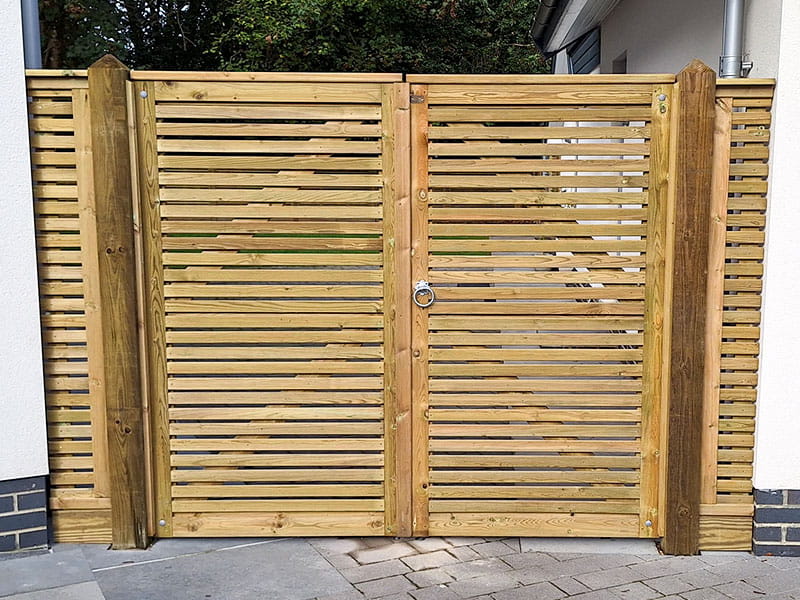
2. Correct Bracing: Supporting the Weight
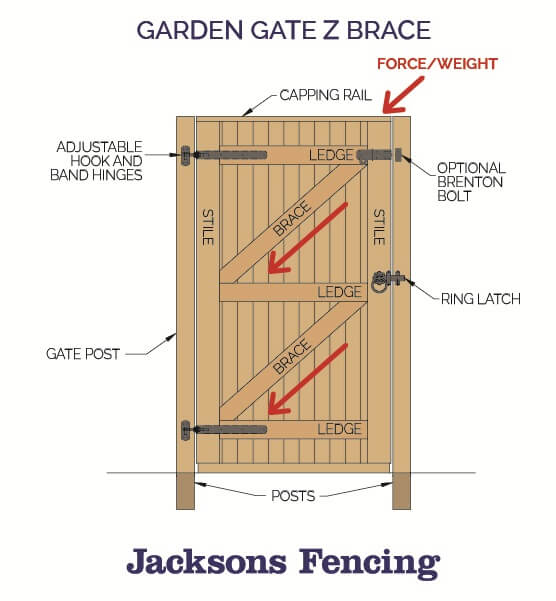
Even the best joints will struggle if a gate is not braced correctly. Bracing prevents sagging and twisting by directing the weight of the gate back towards the hinge side.
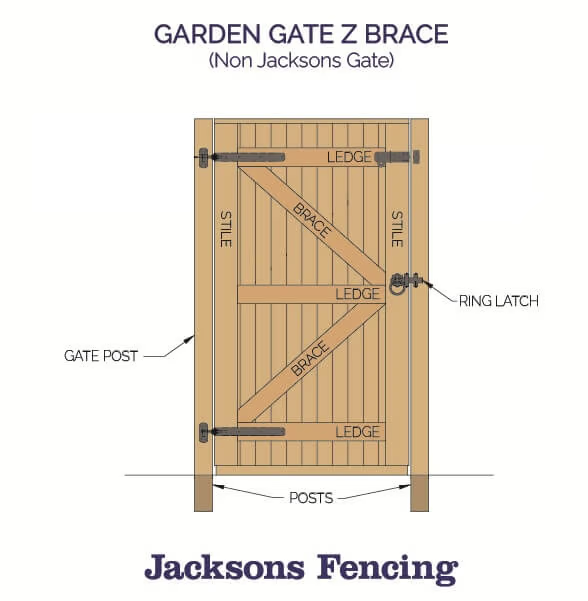
The key principle is that braces should run from the bottom hinge corner up towards the closing side of the gate. This orientation ensures the weight is properly supported. Incorrect bracing such as universal bracing that allows a gate to be hung left or right handed, or decorative bracing that ignores physics, can actually make a gate fail faster. For more information about garden gate bracing, read our blog post.
On heavier or wider gates, bracing becomes even more critical. Without it, gravity will slowly pull the gate out of square, leading to dragging, sticking, and premature wear on hinges and posts. Better still, large wooden gates like Courtyard gates used for driveway entrances should ideally have an internal steel frame to prevent twisting and warping. Read more about why internal steel frames in driveway gates matter.
3. Adjustable Hook and Band Hinges: Precision and Longevity
Hinges play a far bigger role than many people realise. Poor quality hinges or incorrect installation can undermine even the best gate.
Hook and band hinges are the preferred choice for wooden gates because they spread the load across the gate leaf rather than concentrating it in one area. When these hinges are adjustable, they allow the gate to be fine-tuned after installation, throughout the gate’s lifetime.
This adjustability is vital. Timber moves. Ground settles. Being able to raise, lower, or realign a gate without removing it extends its working life, reduces maintenance efforts, and keeps it operating smoothly. Fixed hinges offer no forgiveness and often lead to frustration down the line.

4. Kiln Drying and Pressure Treatment: Preparing the Timber Properly
Great gates start long before assembly. The preparation of the timber itself is crucial.
Kiln drying reduces the moisture content of timber in a controlled environment. This improves stability, reduces the likelihood of excessive movement, and helps treatments penetrate more effectively.
Pressure treatment then protects the timber against rot and fungal decay. By forcing preservatives deep into the wood fibres, pressure treatment provides long-lasting resistance that surface coatings simply cannot match.
Skipping either step may reduce manufacturing costs, but it almost always shortens the lifespan of the gate.
5. Controlled Splits in Posts: Planning for Natural Movement
Large wooden gates require substantial posts, and large sections of timber will almost always crack as they dry and move. This is completely natural, but unmanaged splitting can weaken posts or cause fixings to fail.
One clever solution is to introduce purposeful splits, sometimes referred to as controlled checking. By creating a planned split in the post, movement is guided to occur in a predictable location, rather than randomly.
This level of foresight demonstrates an understanding of timber behaviour. Rather than fighting nature, it works with it, ensuring structural integrity is maintained over the long term.
6. Stainless Steel Fixings: Small Details, Big Impact
Fixings may be hidden, but they play a major role in durability. Ordinary steel fixings will eventually corrode, particularly in outdoor environments. As they rust, they expand, loosening joints and staining timber.
Stainless steel fixings avoid this problem entirely. They do not rust, they maintain a firm hold, and they extend the lifespan of every joint they secure.
While stainless steel costs more upfront, it eliminates a common failure point and reflects a commitment to overall quality rather than short-term savings.
7. A Meaningful Guarantee: Confidence in Construction
A long guarantee is only important if it is backed by sound construction methods. A 25 year guarantee is not just a promise, but a statement of confidence in materials, design and manufacturing processes.
Guarantees should be seen as the result of good engineering, not a substitute for it. Gates built properly, from well prepared timber with thoughtful detailing, earn their longevity rather than relying on fine print.
8. Design That Matches Use
Another often overlooked factor is whether a wooden gate is designed for its purpose. Pedestrian gates, driveway gates, and large entrance gates each place different demands on materials and components.
Heavier gates require thicker sections, stronger joints, and more substantial hardware. Overspecifying may increase cost unnecessarily, while underspecifying leads to early failure. A good gate finds the right balance between strength, appearance, and function.
9. Built to Last, Not Just to Look Good
Many wooden gates look impressive when newly installed, but appearances alone do not determine quality. The real difference becomes clear over time.
A good wooden gate maintains its alignment, opens smoothly, resists decay, and continues to perform year after year with minimal intervention. That performance comes from decisions made during design, material selection, and manufacturing.
When all these elements come together, the result is not just a gate, but a long-term solution.
Related content:
Learn more about the parts of a garden gate:
Discover creative garden gate ideas that enhance your outdoor space, blending practicality, elegance, and security to create the ideal entrance.

Elise is a part of the Jacksons residential marketing team, writing regular columns on gardening, garden design and everything that is garden fencing, gates and structures.